
Make Your PR Award Entries Shine: Tips for Stronger Submissions
PR awards season runs year-round.
Whether you’re eyeing CAPIO, 3CMA, PRSA awards or another program, the best time to start thinking about your entry is long before the deadline.
Our clients know RMG for PR campaigns, strategic planning, special events, podcasting, video, public engagement and a little bit of everything in between.
But did you know we also have a knack for awards?
Over the years, RMG and our clients have earned some of the highest regional, statewide and national honors in public relations and communications. We’ve written plenty of entries, judged plenty more and learned a few things about what separates a good submission from one that rises to the top.
And here’s the good news: The best entries don’t oversell the work. They clearly show judges what you did, why you did it and what you accomplished.
RMG founder Rachel Dickman, MBA, APR, and Dr. Mary Ann Pearson, APR, shared many of these PR award entry tips during a webinar for PRSA Inland Empire on crafting stronger award submissions. PRSA Phoenix recently featured several of those tips on its blog.
Here are a few we swear by.
Start Before Awards Season
One of the best things you can do for yourself is create a living awards file.
As a project unfolds, save the things you may eventually need: research, campaign briefs, photos, videos, media coverage, community feedback, analytics and results.
Because six months from now, you will not remember where that final analytics report lives. You will not remember exactly how many people attended that event. And you definitely won't want to dig through six months of emails looking for it.
Future you will be VERY grateful.
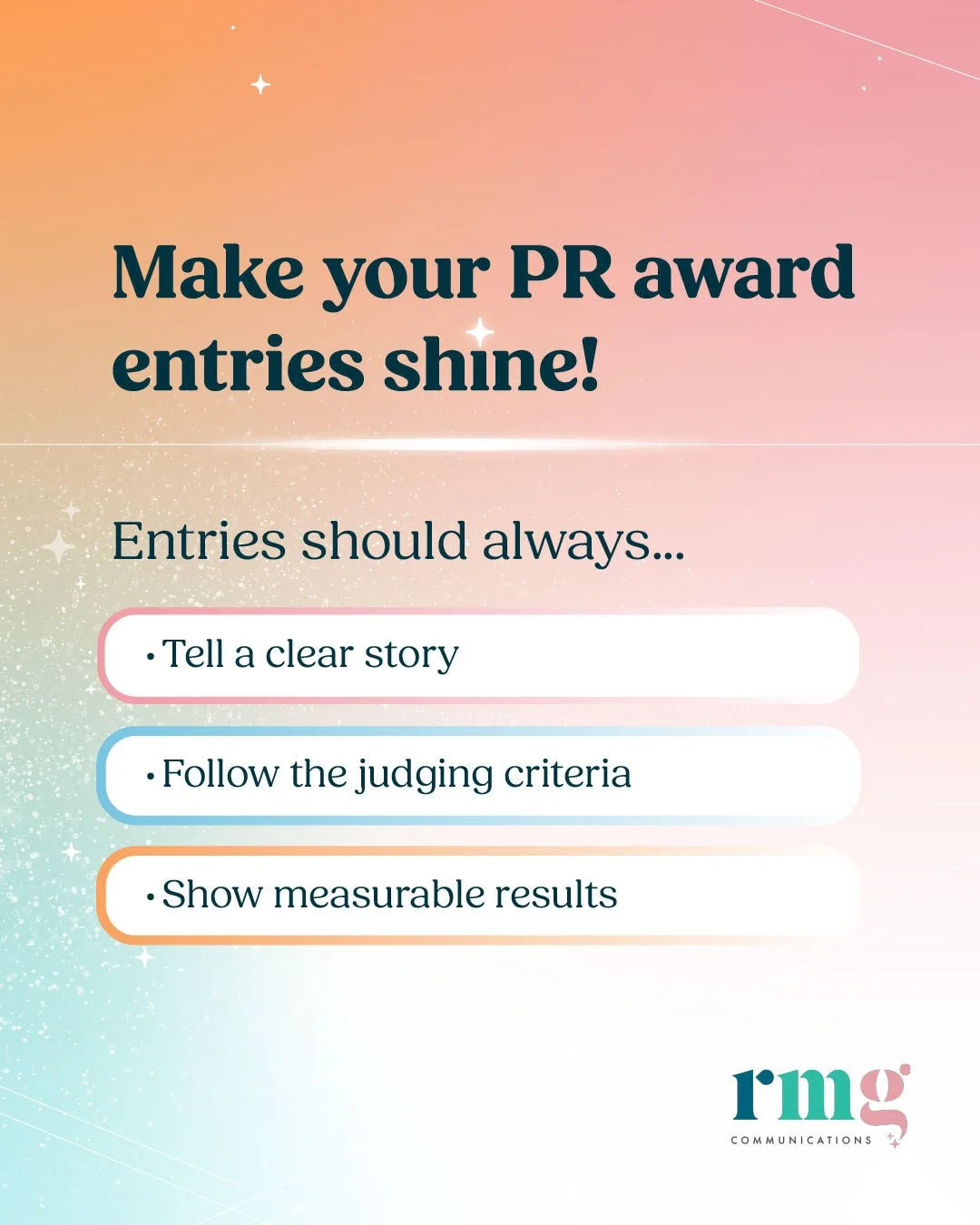
Tell a Clear Story
A strong PR award entry should tell a story that is easy to follow.
What was the challenge? What were you trying to accomplish? What did you do? Why did you do it that way? And what happened as a result?
Judges may be reviewing dozens of entries. A good submission connects those pieces for them. It doesn't give them a laundry list of tactics and expect them to connect the dots.
Your job is to make the story clear.
Read the Judging Criteria. Then Read Them Again.
Every awards program has its own rules. Read them. Seriously.
Different public relations and communications award programs prioritize different things, and even categories within the same program may have different requirements.
Use the judging criteria as your roadmap.
If research is worth 20 points, don't bury it in a paragraph halfway through the entry. If measurable results are part of the score, make sure they're unmistakable.
Don't make judges hunt for your best stuff.
Show Measurable Results
Don't just tell judges your campaign was successful. Show them.
Did attendance increase? Did engagement improve? Did media coverage reach a new audience? Did more people visit your website, sign up for a program, attend an event or take an action?
Whenever possible, connect those results back to the objectives you established at the beginning.
This is also why measurement shouldn't begin when someone says, “Hey, we should enter this for an award.”
Think about how you'll define and measure success while you're planning the project. When awards season comes around, you'll already have the information you need.
Write Like a Judge Will Read It on a Plane
This is one of our favorite pieces of advice because there’s a pretty good chance they might.
Award judges are often communications professionals volunteering their time. They're reading entries between meetings, after work, on weekends and while traveling.
Make their job easier.
Keep your writing clear, concise and easy to follow. Skip the jargon. Don't use five paragraphs when two will do. And don't try to make a straightforward project sound wildly complicated because you think it will be more impressive.
The goal isn't to make the work sound impressive.
The goal is to make it easy for a judge to understand why it was good.
Want to Write Better PR Award Entries? Become a Judge.
If you really want to understand what makes an award entry work, volunteer to judge.
You learn very quickly what makes an entry stand out, what makes one difficult to score and how easily good work can get buried under too much information.
You'll also get to see some fantastic work from other communications professionals, which is one of the best parts.
Great Work Deserves a Strong Entry
Your organization is already doing the work. The award entry is your opportunity to make sure judges understand the strategy, creativity and results behind it.
Start early. Save everything. Follow the criteria. Show your results. Tell a clear story.
And make it easy for the judges to see why the work mattered.
If your team has award-worthy work but not the time or bandwidth to turn it into a strong submission, RMG Communications can help with that too. From identifying the right projects and categories to shaping the story and preparing the final entry, we know our way around an awards portal.
Want more tips? Read the full PRSA Phoenix blog post featuring award-entry advice from Rachel and Mary Ann:
https://phoenixprsa.starchapter.com/blog/copper_anvils_entry_tips
